Touch grass is an application that encourages users to go outside, breathe fresh air, and get sunshine everyday. We often get caught up in our digital worlds, so touch grass provides a daily reminder to embrace things that are real.
Each day, the system provides challenges, such as "Take a photo of the sunset!" or "Hug a tree." Users will take photos to show that they've completed the challenge. Completing challenges daily will contribute to user streaks. To keep users engaged and encourage them to keep using the app everyday, they have a feed that shows their friends' photos for challenges as well. Users can also introduce their own challenge prompts to their friends to add something new and exciting.
Our target audience for touch grass is high school and college students, and our responses consisted of 30 people, with 93.3% being a part of our target audience. The survey covers a few areas of inquiry including the problem we are trying to solve, demand for such a tool, and user design preferences.
Problem: In our survey, we asked questions like "Have you ever spent a whole day without going outside in the past year?" and "What is stopping you from going outside more often?" The goal of these questions was to determine whether lack of activity, specifically outdoor activity, was an issue with high school and college students. 93.3% of users reported spending entire days not going outside within the past year, with 33.3% reporting that they very often spend an entire day indoors. These responses support our initial assumptions and suggest that students are not very active. When asked what is stopping them from going outside, people pointed to lack of motivation (53.3%), not knowing what to do outside (46.7%), and laziness (36.7%) as common reasons.
Demand: To gauge user demand for touch grass, we asked questions like "How often do you seek out new experiences in your daily life?", "Do you wish you spent more time outside?", and "Would you enjoy receiving small daily challenges to change up your daily routine or experience something new?" 86.7% of participants reported seeking out new experiences in daily life. 90% reported that they would want to (or maybe want to) spend more time outside. 80% responded that they would enjoy (or maybe enjoy) receiving daily challenges. These findings suggest that there is interest within our target audience for our app.
Design choices: To help with significant design choices, we asked specific questions about features users would like to see—such as incentives, a social aspect with friends/family, or the ability to create their own challenges. 50% reported wanting competitive tracking like streaks, so we implemented tracking streaks as part of the app to log daily challenge entries. 66.7% wanted to share their content with family and friends, so we added a social aspect. 63.3% expressed interest in introducing their own challenges, so we included this feature as well.
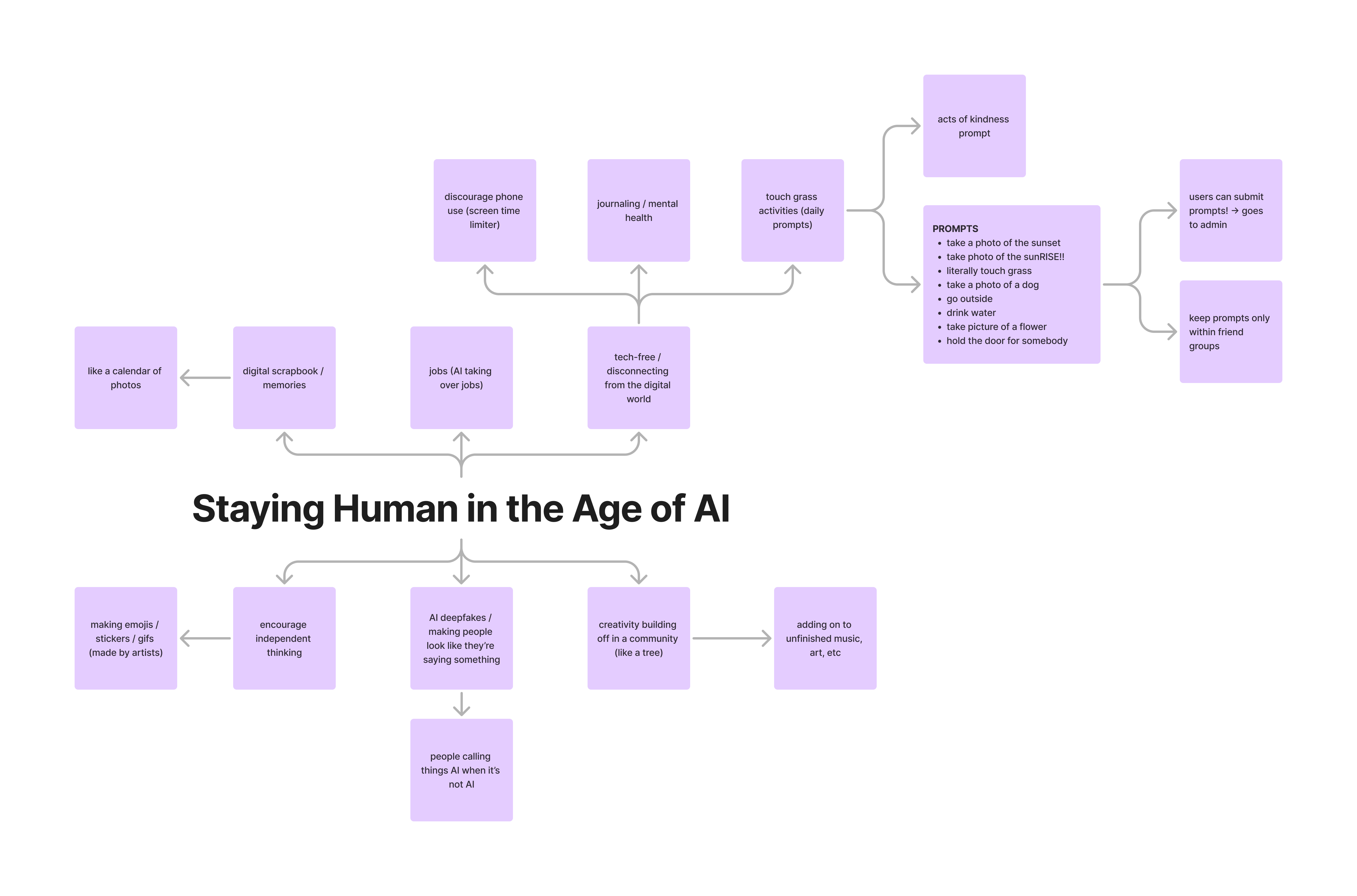
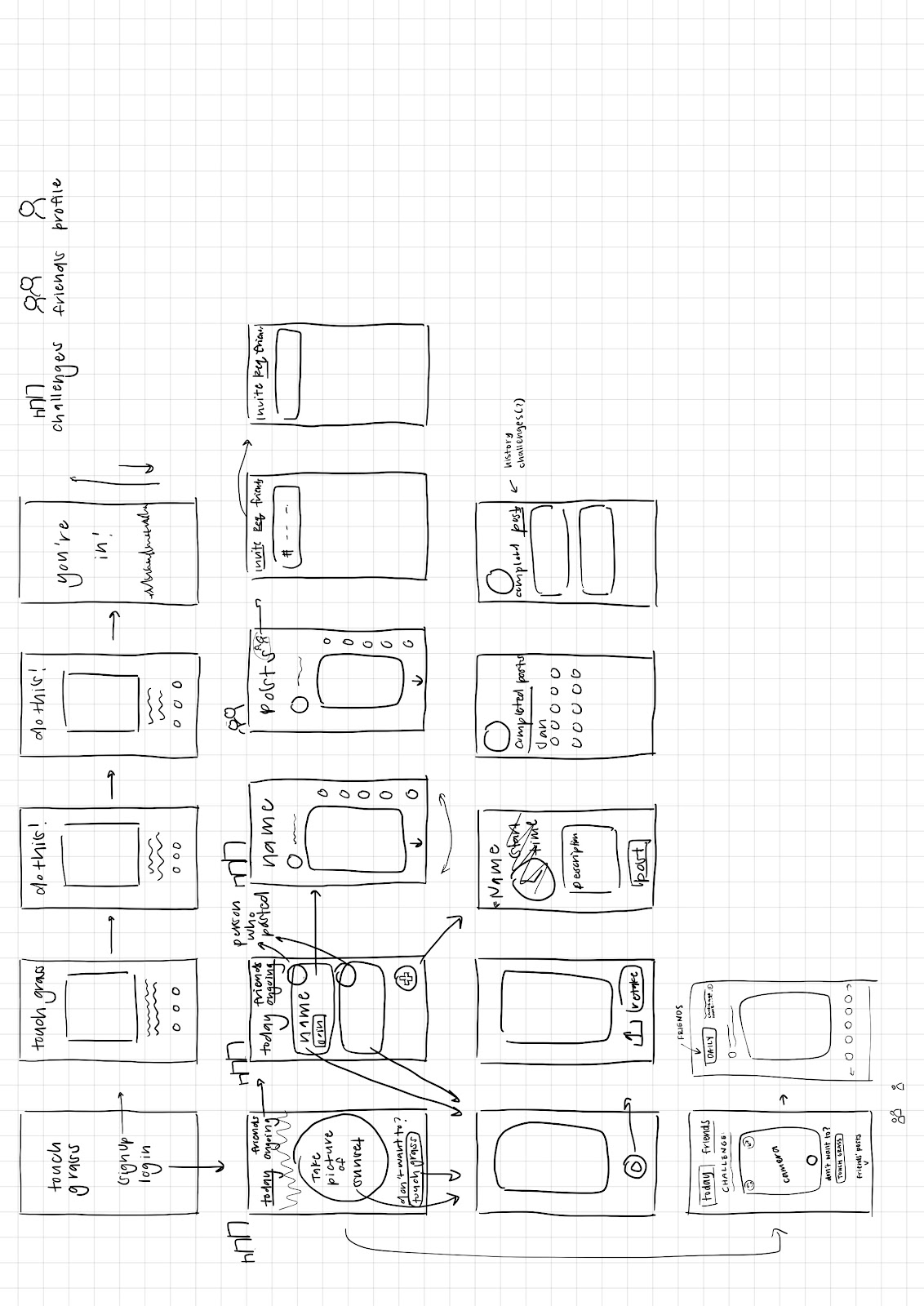
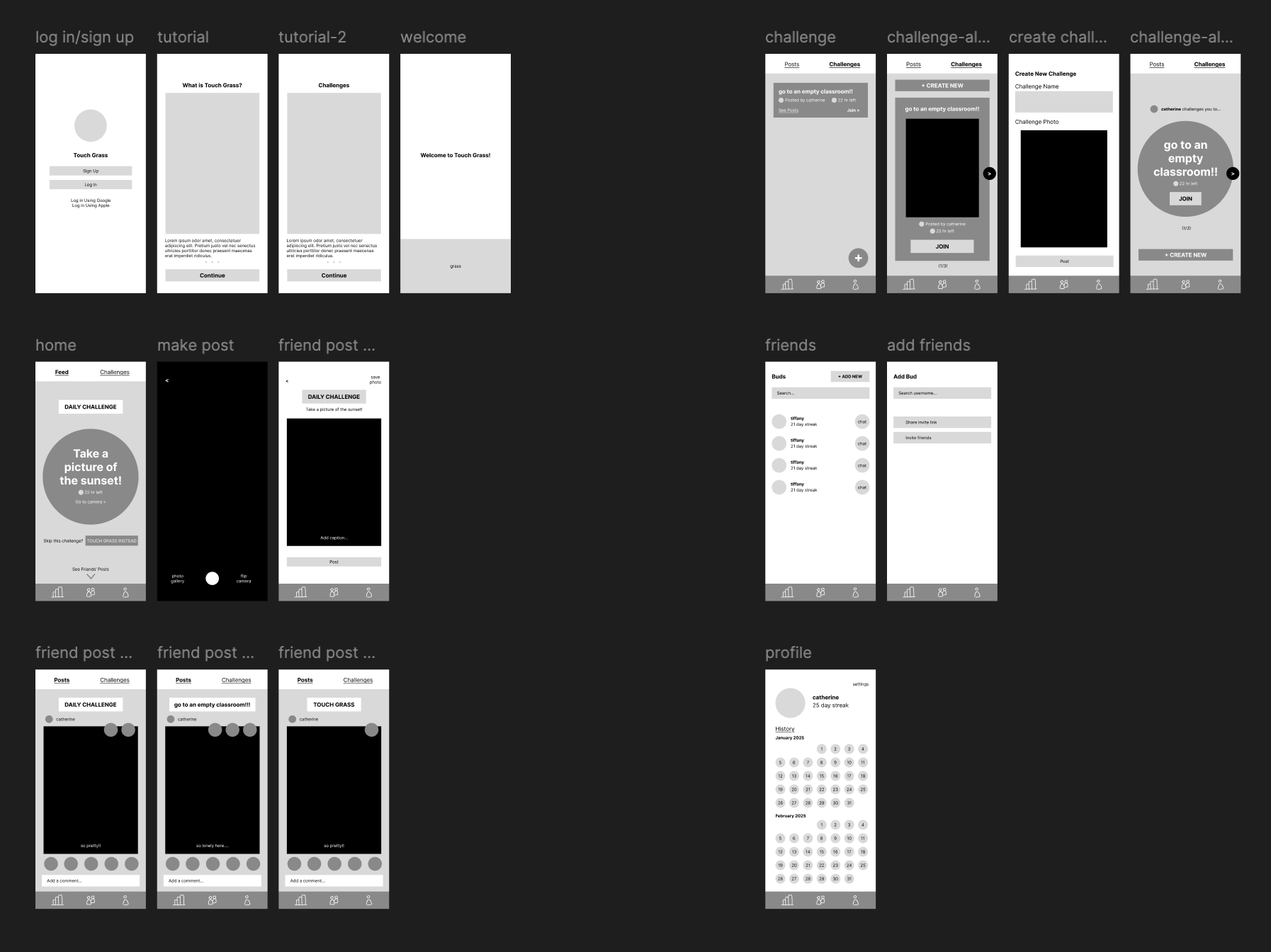
Application name: The phrase "touch grass" inspired the idea for our app. The roots of this phrase embody the perceived problem, and the phrase itself is a representative solution, so it was a clear choice to name our app "touch grass." Our slogan is "Go outside, touch grass."
Color scheme and branding: Our app uses a green and brown color scheme to reflect nature, reinforcing our goal of regular outdoor activity. For typography, we chose DM Sans for its simplicity. We hand-drew elements like the logo and challenge frames to create a unique, casual aesthetic. This helped differentiate us from overly serene nature apps or overstimulating social media apps. We also incorporated nature-themed terminology, like calling friends "buds" and using "sprout" for creating challenges.
Social Aspect: Our research revealed that 80% of respondents wanted to share activity with friends/family. Open-ended responses highlighted desires for "something fun with friends" or "a social aspect like BeReal." To address concerns about "losing interest", we prioritized social interaction—placing friends' posts on a feed-like homepage and letting users "sprout" their own challenges. This makes outdoor activities feel more fun and collaborative.
Streaks and Calendar Tracking: Survey results showed 50% preferred competitive incentives (e.g., streaks), while 41.2% wanted progress tracking without penalties. We balanced these by implementing low-pressure streaks—users can maintain them by simply "touching grass" if a challenge isn't feasible. We also added a calendar feature to visualize past activities, helping users reflect on memorable moments outdoors.
Throughout the design process, we prioritized simplicity and engagement, ensuring the app remains fun and accessible. By blending nature-inspired branding, social features, and flexible tracking, we created an experience that encourages daily outdoor activity without overwhelm.